Showing posts with label Infrastructure. Show all posts

Sunday, January 8, 2017

CCM vs. PMP - What do you want to be when you grow up?

 A castle in the clouds design concept by artist Raphael Lacoste.
Initiation

Recently in my network I have become point person for what I affectionately term: "PMP-iatry." At least once a week colleagues or acquaintances contact me wondering about requirements or the experience of certifying as a PMP.

This past week, a colleague invited me to coffee to asking what is necessary in order to start working on certification requirements. On the way to coffee, I asked him what I always ask at the outset of this conversation: "What do you want to be when you grow up?"

Requirements Management

Without much prompting, he mentioned his desire to continue the family construction business, and certification would be his key to success. I countered this assertion saying he could easily succeed in business by focusing on processes he already knew and hiring someone with a CCM. The idea that multiple styles of project management certifications exist was foreign to him. So, I began to explain what I learned from having spent the last few years inside a construction PMO, interacting with CCMs, reviewing materials from both exams and passing the PMP.

Both exams share essential parallels. Understandings of the critical project management functions: scope, resources, schedule, risk, contract and stakeholder management all match up. Safety management, for example, is not an implicit PMP requirement. However, these items a PM could - either with a mentorship component or subject matter expert utilization, - absorb quickly along with taking the OSHA training. During training, a crossover PM could easily begin responsibilities in the CM world, and once properly trained and assessed, venture out on their own.

The 'responsible-in-charge' requirement is a frequent point of contention, but profitable management of projects is common between both certifications. Pivoting towards profitability, discovering efficiencies, eliminating wasteful practices, and change management are defined areas of study under the PMP. 

It is also true that, of the nearly 650,000 PMPs compared to 3,400 CCMs, a good chunk are not in RIC roles. Many are though, and have direct responsibility with projects of a scope complexity, scale and budget comparable to construction projects.

Change Management

So what's the point David? 
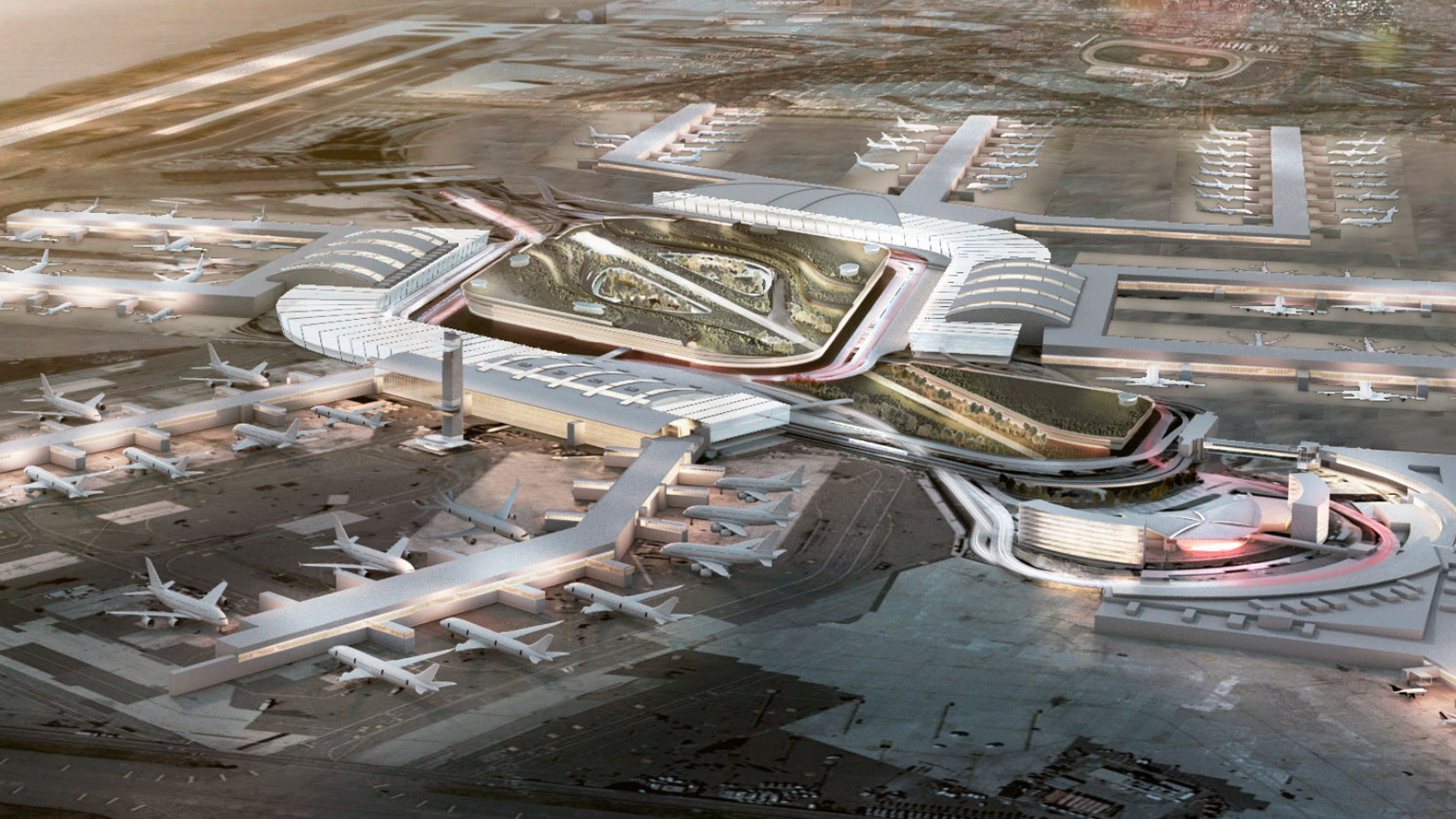
JFK revamp plans
Rendering of  Governor Cuomo's
proposed JFK renovation


It is the following: Capital dollars spent by all three sectors vary widely annually. If the $1.0 Trillion infrastructure program ever materializes, the project backlog will be outrageous. Just now in New York, Governor Cuomo announced $10 Billion for JFK Airport renovations before the $3.0 Billion LaGuardia renovation is finished. Neither of those amounts take into account the commercial and residential construction that should kick off this year.


When all of those projects go live, there won't just be a labor supply gap. There will be an inescapable vacuum that irrevocably stalls on time and budget project delivery. Surveying industry openings just inside of LinkedIn a deficit of sufficient CCM supply already exists, while a veritable plethora of PMPs is available, many of whom are actively looking for strong opportunities.

Closeout

This represents a chance for the construction industry to pivot towards profitability. Creating mentorship and talent attraction/retention programs will pay dividends off into the out years. PMI and CMAA should develop inter-agency cooperation, and practitioners from both certifications need to be involved in the cross walk. However, the end product should be a freshly minted Construction PM able to glide seamlessly from one environment to the next and back again. Enough CM firms of sufficient size and heft exist that such a thing ought to easily spontaneously generate, and be standardizable across organizations. Feel free to contact me for some ideas.

So, what do you want to be when you grow up?

The EkranoYacht. A design concept winner from Australia, powered by Hydrogen. What's in your future?

Friday, November 25, 2016

Constructing the Future.

Image from Skanska USA - Planned LaGuardia Airport
upgrade.
Construction is an industry bound to see sustained solid growth in the both the near and distant future. Of course, as a New Yorker working on a $3 Billion public works construction program, you might say my view is skewed. However, sitting inside the industry, and being cognizant of upcoming trends, allow me to elucidate.

A vision of the New New York Bridge,
We are somewhat lucky in New York, and not least of which, the City of New York, where mega projects happen concurrently in a variety of locations. The major LaGuardia Airport renovation recently began spinning up to the tune of $4 Billion. Large swaths of that money is dedicated to be spent on subcontractors and firms capable of taking on smaller pieces of the larger project. At the same time as the LaGuardia project announced its commencement, Governor Cuomo additionally announced $3 Billion dollars for the refurbishment and renovation of New York Penn Station as a world class transportation hub through a public private partnership.

Lastly, another $1 Billion has been announced for added transportation construction of a third rail line on the LIRR. All of this, of course, is aside from the significant housing construction set to start up as developers activated projects before expiration of the 421-a tax credit, and separate from the New Tappan Zee Bridge (also known as The New New York Bridge) already underway with a total project budget of $3.98 Billion.

But that is just New York. The rest of the country is similarly seeing either the need for, or the current stimulation of the construction industry. The World Economic Forum issued a report in May of this year saying: “ The construction industry serves almost all other industries, as all economic value creation occurs within or by means of buildings or other “constructed assets”. As an industry, moreover, it accounts for 6% of global GDP. It is also the largest global consumer of raw materials,...” That total is significant, making “constructed assets” all the more important.

By way of example of projects soon to come through the construction pipeline: The United States New England region - Connecticut, Rhode Island, and Massachusetts - began leveraging their collective bargaining power as a triumvirate of entities for the purchase of clean energy megaprojects. The largest offshore wind farm recently concluded its construction just off the shore of
The Deepwater Wind project off
Rhode Island's shore in the Long
Island Sound.
Rhode Island and is producing 30 MW of electricity. Not megalithic on any scale, but
Rhode Island is not in need of, for example, the 120 MW necessary for running New York State. Other projects are sure to follow as multistate reforms to our power grids and energy distribution occur. Beyond energy industry refurbishment, nationwide transportation infrastructure currently ranks exceedingly low. An October, 2015 Fortune article cites the Economic Policy Institute finding that roads, bridges, rail, and air transport systems are in direct danger of critical collapse without upgrades and improvements. One plan to utilize $275 Billion in infrastructure banks for seed money to spur infrastructure spending is an idea that promises to grow and sustain the heavy construction industry around the country for years to come. Driving on those upgraded and refurbished roads will be the vehicles of the future, and highly skilled, futuretech constructors will be necessary for either out-of-the-ground development, or wholesale repurposing of existing locations for their production.

These totals and projects are all public institution related and funded. The amounts and directions of projects from the private industry will demonstrate a yawning chasm of difference in their price tags and style. However, the variety and viability of private industry megaprojects will similarly be dependent on transportation, energy distribution, and supply infrastructure meaning that the completion of both have interdependencies. The two things in combination are bound to create a growth opportunity for constructors for years to come.